
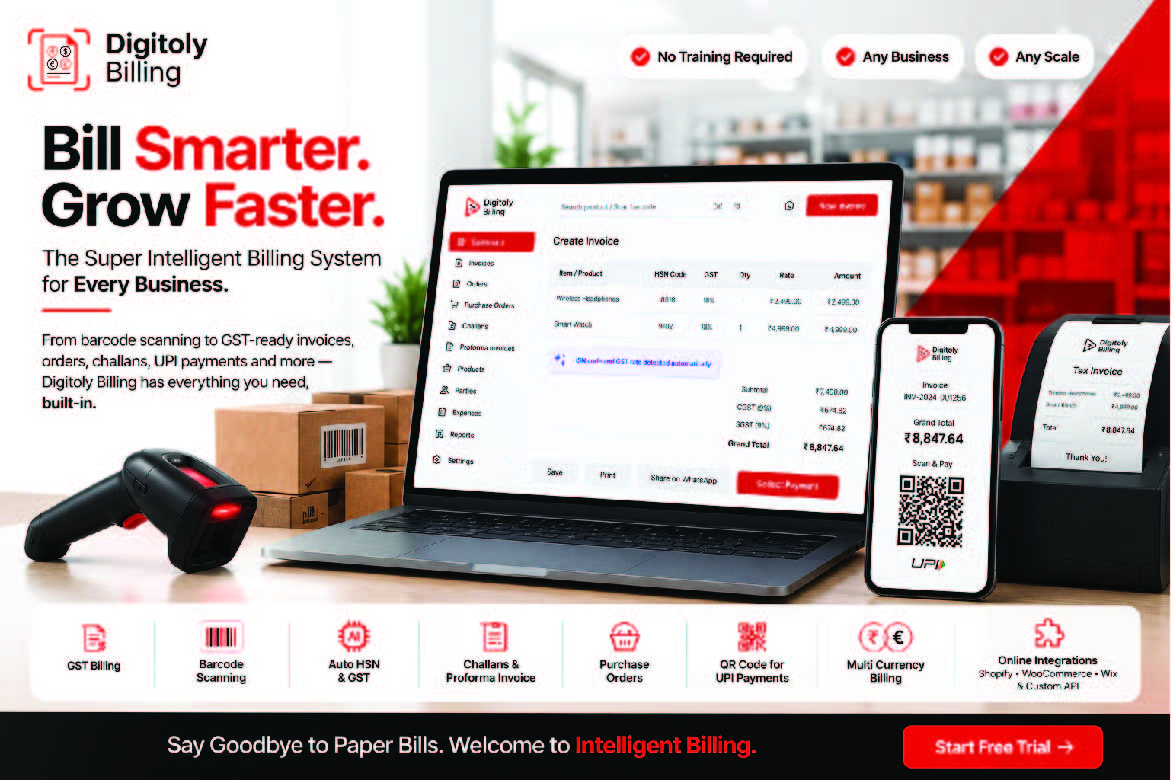
Billing is one of the most important parts of running a business. Every sale needs proper documentation. Products need to be identified. Taxes need to be calculated. Customers need invoices. Payments need to be collected. Orders need to be managed. Purchase records need to be maintained. Businesses may also need challans, proforma invoices, GST reports, and other documents. For many businesses, all of this can become time-consuming. It becomes even harder when billing depends on paper records, manual calculations, spreadsheets, or multiple disconnected software systems.
Digitoly Billing was built to make this entire process simpler.
Initially, the system was created with one clear objective: to eliminate paper billing. It has since evolved into a super-intelligent billing system designed to help businesses automate and simplify their everyday billing requirements.
Digitoly Billing is designed for businesses of any type and any scale. It can be used by offline businesses, online businesses, service providers, retailers, growing companies, and businesses operating through both physical and digital channels.
The platform brings essential billing capabilities together in one place, including smart GST billing, automatic HSN and GST identification, barcode scanning, invoices, challans, proforma invoices, orders, purchase orders, RCM, UPI QR payments, multi-currency billing, WhatsApp invoice sharing, GST reports, and integrations with platforms such as Shopify, WooCommerce, Wix, and custom systems.
The official Digitoly Billing FAQ also highlights features including GST compliance, HSN auto-detection, IGST versus CGST + SGST handling, barcode scanning, WhatsApp invoice sharing, QR-code payments, GST reports, data export, and support.
Let’s take a detailed look at what makes Digitoly Billing different.
What is Digitoly Billing?
Digitoly Billing is a digital billing platform designed to make business billing simple, fast, and intelligent.
It is not designed only for creating a basic invoice.
Instead, it brings many of the processes businesses need around sales, billing, taxation, payments, purchasing, and documentation into one system.
The idea is straightforward.
Businesses should not need to become accounting experts just to create a bill.
Digitoly Billing handles many complex billing processes in the background so users can work with a simpler interface.
This makes it suitable for people who have little or no GST knowledge.
There is also no need for complicated training before using the system. The platform has its essential billing systems built in, allowing businesses to get started without spending days learning complicated software.
The official FAQ specifically addresses whether accounting knowledge is required, how quickly a first bill can be created, software installation, and the availability of a free trial.
Smart GST Billing
GST billing is one of the core requirements for many Indian businesses.
However, creating a GST-compliant bill can involve several steps.
Businesses may need to identify the correct product classification, find the relevant HSN code, apply the correct GST rate, calculate taxes, and determine whether the transaction requires IGST or CGST and SGST.
Doing this manually for every transaction can take time.
Digitoly Billing is designed to simplify this process.
The system can automatically identify relevant HSN information and GST rates based on the product.
It can also determine whether the applicable tax treatment involves IGST or CGST + SGST.
The official FAQ specifically lists GST compliance, HSN auto-detection, and automatic IGST versus CGST + SGST handling among its GST and compliance capabilities.
The result is a much simpler billing workflow.
Instead of constantly searching for tax information, users can let the billing system handle much of that work automatically.
Automatic HSN Code Detection
HSN codes are an important part of GST billing.
But manually searching for the correct HSN code every time a product is added can be frustrating.
Digitoly Billing addresses this through automatic HSN code detection.
When a product is identified, the system can automatically fetch the relevant HSN information.
This is particularly useful for businesses with many products.
Imagine a shop with hundreds or thousands of products.
Without automation, employees may have to search for product classifications repeatedly.
With Digitoly Billing, much of that repetitive work can be automated.
This is one of the features that makes Digitoly Billing more than a simple invoice generator.
Automatic GST Rate Identification
Finding the HSN code is only part of the process.
The applicable GST rate also needs to be identified.
Digitoly Billing can automatically fetch the GST rate based on the identified HSN information.
This creates a convenient workflow:
Identify the product → Fetch HSN → Identify GST rate → Add the product to the bill.
The user does not need to manually search for the HSN and GST information every time.
This is particularly helpful for business owners and employees who do not have extensive GST knowledge.
Instead of making users remember tax information, Digitoly Billing puts automation into the billing process.
Built-In Barcode Scanner
Barcode scanning is another major feature of Digitoly Billing.
The system has a built-in barcode scanner that can scan product barcodes directly.
This means businesses do not have to depend entirely on manual product entry.
A user can scan a product and add it to the bill.
For businesses that handle a large number of physical products, this can significantly speed up billing.
It can be particularly useful at busy counters where every second matters.
The official FAQ confirms that barcode scanning is supported as one of Digitoly Billing’s features.
What if the Product Has No Barcode?
Not every product has a barcode.
Digitoly Billing has a solution for that as well.
Users can simply enter the product name manually.
Once the product name is entered, the system can automatically fetch the relevant HSN code and GST information.
This gives businesses two simple ways to add products.
When a barcode is available
Scan barcode → Product identified → HSN fetched → GST identified → Add to bill
When a barcode is unavailable
Enter product name → Product identified → HSN fetched → GST identified → Add to bill
This flexibility means businesses are not forced to change their entire product catalogue just to use the system.
GST Billing Without Being a GST Expert
One of the strongest ideas behind Digitoly Billing is accessibility.
Many business owners are experts in their own businesses.
A shop owner understands their products.
A service provider understands their customers.
An entrepreneur understands their market.
But that does not mean everyone has detailed GST knowledge.
Digitoly Billing is designed for those users too.
The system has built-in functionality that handles important GST-related processes.
Users can create bills without needing to understand every technical detail behind GST calculations.
The objective is simple:
Let the software handle the complexity while the user handles the business.
This makes the platform particularly useful for small businesses and growing businesses that may not have dedicated accounting staff.
GST Reports for Your CA
Billing does not end when an invoice is created.
Businesses also need records and reports.
Digitoly Billing provides GST reporting capabilities, and the official FAQ specifically addresses access to GST reports by a Chartered Accountant.
This can make collaboration with a CA easier.
Instead of relying entirely on paper records, businesses can maintain their billing information digitally and provide relevant reports when needed.
The platform also supports data export, giving businesses greater control over their information.
Challans Built Into the System
Businesses often need more than invoices.
Depending on the transaction, a challan may be required.
Digitoly Billing includes challan functionality within the billing system.
This means businesses can create and manage challans without needing to rely on a completely separate tool.
Keeping these documents within the same billing environment can make everyday operations more organised.
Proforma Invoices
A proforma invoice can be useful when a business needs to provide a preliminary invoice or quotation-style document before completing a transaction.
Digitoly Billing includes proforma invoice functionality as part of its built-in billing tools.
This allows businesses to handle different stages of the sales process within the same system.
Instead of using one tool for a proforma invoice and another for the final bill, businesses can keep the workflow connected.
Create New Orders
Sales do not always begin with an immediate invoice.
A customer may first place an order.
Digitoly Billing supports new order creation, allowing businesses to manage orders as part of their billing workflow.
This can help businesses keep sales activity more organised.
It also means the system is designed around the broader business transaction rather than only the final invoice.
Purchase Orders
Businesses do not only sell products.
They also purchase products, materials, stock, and other items.
Digitoly Billing includes purchase order functionality to support this side of business operations.
Having purchase orders within the same system can help businesses keep purchasing activities better organised.
It also reduces the need to maintain separate documents using unrelated tools.
RCM Support
Certain GST transactions may involve the Reverse Charge Mechanism, or RCM.
RCM can add complexity to billing and tax-related processes.
Digitoly Billing includes RCM functionality as part of its broader billing system.
This gives businesses that need RCM support access to the functionality within the same billing environment.
The broader goal remains the same: reduce manual work and keep essential billing processes together.
QR Code Payments for UPI
Payments are an essential part of billing.
Once the invoice is generated, the customer needs a convenient way to pay.
Digitoly Billing supports QR-code payments for UPI.
A QR code can be provided on the bill so customers can scan it and make their payment.
This can make the payment process faster and more convenient.
For businesses serving customers at physical locations, it can also reduce the need for manual payment instructions.
The official FAQ specifically confirms that customers can pay by scanning a QR code on the bill.
WhatsApp Invoice Sharing
Printed invoices are not always necessary anymore.
Customers increasingly expect digital copies of their bills.
Digitoly Billing supports invoice sharing through WhatsApp.
This allows businesses to send invoices digitally rather than automatically printing every bill.
It also connects directly with the original idea behind Digitoly Billing: reducing paper billing.
A customer can complete a purchase and receive the invoice digitally.
This is simple for the business and convenient for the customer.
The official FAQ lists WhatsApp invoice sharing among the platform’s features.
Multi-Currency Billing
Businesses are no longer restricted to selling within their local markets.
An online business may serve international customers.
A service provider may work with overseas clients.
An exporter may deal with customers in different countries.
Digitoly Billing supports multi-currency billing, making it useful for businesses that need to create bills in different currencies.
This makes the platform suitable for businesses with international billing requirements as well as businesses operating primarily in the domestic market.
Shopify Integration
Many businesses use Shopify to operate their online stores.
But an e-commerce platform and a billing system serve different purposes.
Digitoly Billing can be integrated with Shopify, allowing businesses to connect their online selling environment with their billing workflow.
This is particularly useful for businesses that sell online but still need proper billing and GST-related processes.
Instead of manually transferring information between systems, integration can help create a more connected workflow.
WooCommerce Integration
WooCommerce is another popular platform for businesses operating online stores.
Digitoly Billing can integrate with WooCommerce, giving businesses another way to connect their online sales environment with their billing system.
This is especially useful for businesses that operate their own WordPress-based e-commerce websites.
Wix Integration
Businesses using Wix for their websites and online stores can also connect with Digitoly Billing.
This gives Wix-based businesses another option for integrating billing into their digital operations.
The ability to connect with different platforms is important because businesses should not have to rebuild their entire online presence just to adopt a billing system.
Custom API Integration
Not every business uses Shopify, WooCommerce, or Wix.
Some businesses have custom websites.
Others have their own applications, ERP systems, marketplaces, or specialised software.
Digitoly Billing supports custom API integration, allowing businesses to connect their own systems with the billing platform.
This provides considerably more flexibility than a billing system that works only with a fixed list of platforms.
For growing businesses with custom technology requirements, this can be particularly valuable.
Designed for Offline, Online and Hybrid Businesses
Digitoly Billing is not restricted to online businesses.
It is also not limited to traditional physical stores.
It is designed for offline businesses, online businesses, and businesses that operate through both channels.
A physical retailer can use barcode scanning and QR payments.
An online business can use e-commerce integrations.
A service provider can create invoices and other documents.
A hybrid business can use the same billing system across its physical and digital operations.
This flexibility makes Digitoly Billing suitable for businesses at different stages of growth.
Suitable for Any Type of Business
Another important point is that Digitoly Billing is not designed around one specific industry.
It can be used by different types of businesses.
That can include retail stores, service providers, restaurants, bakeries, jewellery businesses, wholesalers, online sellers, and many other business models.
The official FAQ specifically addresses use cases such as bakeries, restaurants, and jewellers, including barcode scanning and other billing capabilities.
However, these are examples rather than limitations.
The platform’s broader purpose is to provide billing tools that can work for businesses of different types and sizes.
No Software Installation Required
Traditional billing software can sometimes require installation and maintenance on specific computers.
Digitoly Billing is designed as an online billing platform, so users do not need to install traditional billing software or an app to get started.
This makes accessing the system easier for businesses that want a more flexible billing environment.
The official FAQ specifically addresses whether users need to install software or an app.
Data Export and Business Data Management
Digital billing creates another important advantage.
Information becomes easier to manage than stacks of paper invoices.
Digitoly Billing provides a data export facility, giving businesses the ability to export their information when required.
The platform also provides information about data storage and privacy through its FAQ, addressing common concerns businesses may have when moving their billing processes online.
For a business moving away from paper billing, digital data management is an important part of the transition.
Simple Enough for Beginners, Powerful Enough for Growing Businesses
Software often forces businesses to choose between simplicity and functionality.
Basic tools may be easy to use but lack important features.
Advanced systems may provide many features but become difficult to learn.
Digitoly Billing aims to bridge that gap.
The interface is designed to be simple enough for users without extensive accounting knowledge while providing a broad set of business billing capabilities.
That means a business does not necessarily need a dedicated software expert just to create an invoice.
The system is designed to make the process intuitive.
Fast Billing for Busy Businesses
Speed matters in business.
A customer waiting at a busy counter does not want to wait while an employee searches for tax information.
A business owner processing multiple orders does not want to repeatedly enter the same information.
A service provider should not have to spend a large part of the day preparing invoices.
Automation helps reduce these delays.
Barcode scanning, automatic HSN and GST identification, built-in documents, digital payments, and invoice sharing can all contribute to a faster billing workflow.
The objective is not simply to provide more features.
The objective is to reduce the amount of work required to complete a billing task.
Affordable Billing Without Unnecessary Complexity
Business software needs to make financial sense.
A small business may not have a large software budget.
A growing business may want more functionality without dramatically increasing its technology costs.
Digitoly Billing is designed to offer its broad set of billing capabilities at an affordable price.
The platform also offers a free trial, allowing businesses to explore the system before choosing a plan. The official FAQ provides information about trials, plans, invoice limits, plan changes, annual discounts, payments, and cancellation.
This makes it easier for businesses to evaluate the system based on their actual workflow.
Built Around the Goal of Eliminating Paper Billing
All these features connect back to the original purpose of Digitoly Billing.
The system was initially built to eliminate paper billing.
But the real objective is bigger than simply replacing a printed invoice with a digital one.
It is about eliminating unnecessary manual processes.
Think about the traditional process.
A business owner writes or prints an invoice.
The employee manually enters product details.
Someone searches for the HSN code.
Someone checks the GST rate.
The tax is calculated.
The bill is printed.
The customer pays separately.
The invoice may then be stored physically.
Later, someone may need to search through those documents for reporting.
Digitoly Billing brings many of these steps into one digital workflow.
A product can be scanned.
The HSN and GST information can be identified automatically.
The bill can be created.
The customer can pay through a QR code.
The invoice can be shared through WhatsApp.
The billing information can be managed digitally.
That is the real meaning of intelligent billing.
Digitoly Billing: More Than an Invoice Generator
When all these features are considered together, Digitoly Billing becomes much more than a tool for creating invoices.
It brings together:
- Smart GST billing
- Automatic HSN identification
- Automatic GST-rate identification
- Built-in barcode scanning
- Product-name-based identification
- IGST and CGST + SGST handling
- GST reports
- Challans
- Proforma invoices
- New orders
- Purchase orders
- RCM
- UPI QR payments
- WhatsApp invoice sharing
- Multi-currency billing
- Data export
- Shopify integration
- WooCommerce integration
- Wix integration
- Custom API integration
The official FAQ confirms many of the platform’s GST, billing, feature, data, and support capabilities.
And because these capabilities are designed to work within one billing environment, businesses can avoid creating a complicated collection of separate tools for everyday billing tasks.
Why Businesses Should Look Beyond Basic Billing Software
The right billing system should do more than generate a PDF invoice.
It should help businesses save time and reduce repetitive work, make tax-related billing easier, support different types of documents, make payments convenient, work with online platforms, support businesses as they grow.
And, most importantly, it should be simple enough for everyday users.
Digitoly Billing has been designed around these principles.
Whether you are running a physical store, an online business, a service company, a growing retail operation, or a business that combines offline and online sales, the system is designed to give you the tools required to manage billing more efficiently.
Final Thoughts
Modern businesses do not need more complicated software.
They need smarter software.
Digitoly Billing takes the complexity out of many everyday billing activities by combining automation, GST functionality, product identification, business documents, payments, reporting, and integrations in one platform.
Its built-in barcode scanner can speed up product entry and automatic HSN and GST identification can reduce manual tax-related work. Its built-in challans, proforma invoices, orders, purchase orders, and RCM support help businesses manage more than just basic invoices.
The QR-code payment functionality makes UPI payments easier.
Its WhatsApp sharing makes digital invoice delivery simple.
Its multi-currency functionality supports businesses dealing with international customers.
And its Shopify, WooCommerce, Wix, and custom API integrations allow online businesses to connect billing with their existing systems.
Most importantly, no complicated training is required.
A person does not need to be a GST expert to start using the system.
That simplicity is central to the Digitoly Billing experience.
What began as an effort to eliminate paper billing has evolved into a super-intelligent billing system for businesses of any type and any scale, whether they operate offline, online, or both.
The goal is simple:
No paperwork. Less manual work. No complexity. Faster billing.
If your business is still spending too much time creating bills, searching for HSN codes, calculating GST, managing paper records, or switching between multiple billing tools, Digitoly Billing is worth exploring.
Experience smarter billing with Digitoly Billing and discover how simple business billing can be.

