
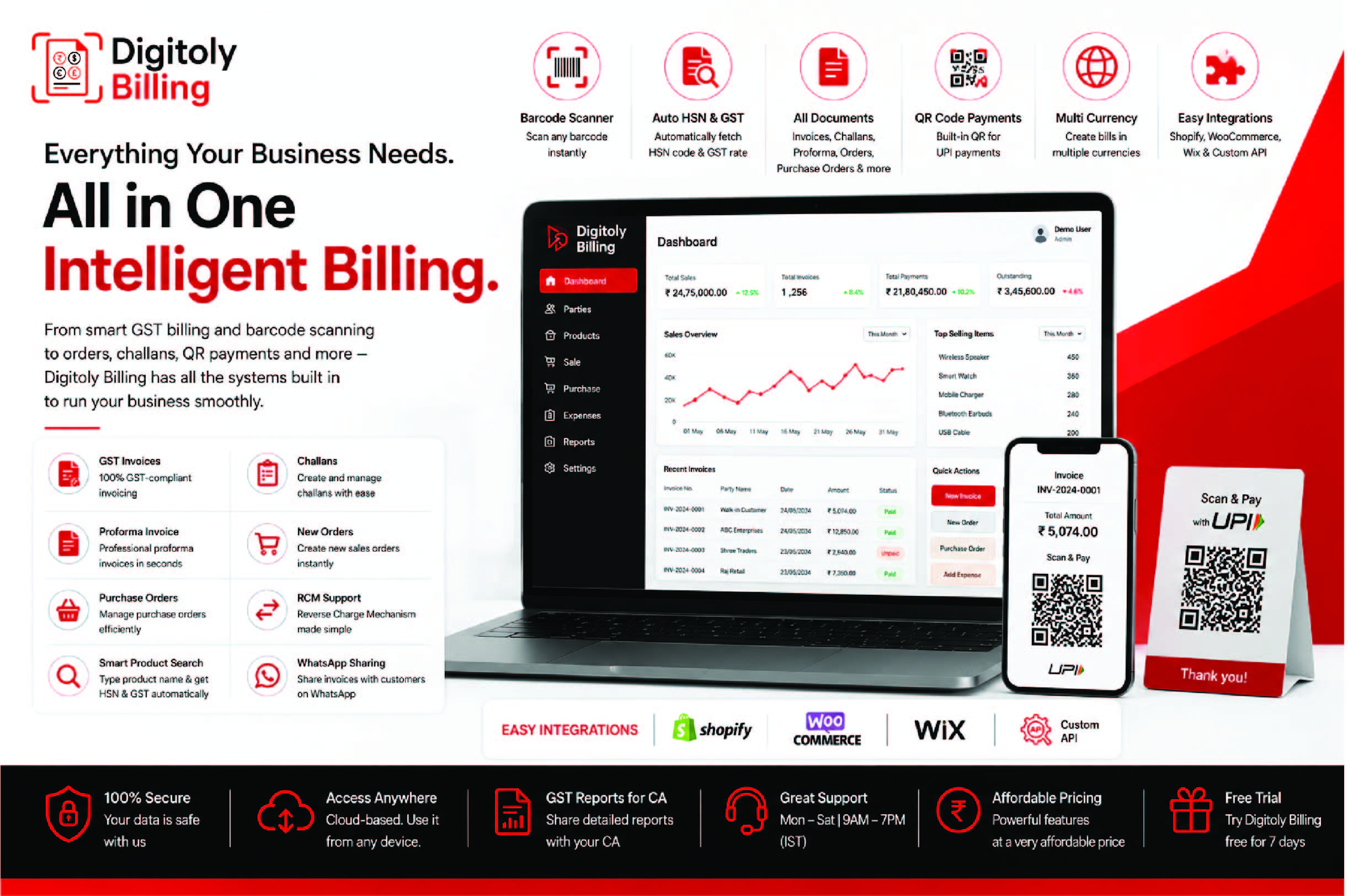
Business billing should not be complicated. Yet, for many business owners, creating invoices is still surrounded by manual work. They have to enter product details, search for HSN codes, check GST rates, calculate taxes, maintain records, manage orders, prepare different types of documents, and keep track of payments. For businesses that still depend on paper bills, the problem becomes even bigger. Digitoly Billing was initially built with a simple goal: to eliminate paper billing and make the entire billing process digital, simple, and faster.
Today, it has grown into a smart billing system designed for businesses of different types and sizes. Whether a business operates from a physical store, sells online, provides services, or combines online and offline sales, Digitoly Billing can fit into its workflow.
The best part is that users do not need extensive accounting knowledge or complicated training to get started. The system is designed to handle many of the complicated billing tasks in the background.
From smart GST billing and automatic HSN identification to barcode scanning, QR-based UPI payments, multi-currency billing, purchase orders, challans, proforma invoices, and e-commerce integrations, Digitoly Billing brings essential business billing tools together in one place.
What is Digitoly Billing?
Digitoly Billing is a digital billing platform designed to simplify invoicing and other everyday billing requirements for businesses.
Its purpose goes beyond replacing a handwritten bill with a digital invoice.
The idea is to reduce the amount of manual work involved in creating and managing bills.
The platform provides tools for GST billing, product management, orders, purchase orders, challans, proforma invoices, payments, reports, and other business billing activities.
It is also designed to make GST-related billing easier for people who may not have detailed knowledge of GST.
The official Digitoly Billing FAQ specifically addresses ease of use, GST compliance, HSN auto-detection, tax treatment, barcode scanning, WhatsApp invoice sharing, QR-code payments, data export, and other common billing requirements.
In simple terms, Digitoly Billing aims to answer one important question:
Why should a business owner spend valuable time doing repetitive billing work when the software can do much of it automatically?
Built to Eliminate Paper Billing
The story behind Digitoly Billing starts with paper. For years, businesses have relied on handwritten bills, printed invoices, physical records, and manual calculations.
Paper billing may appear simple at first. However, as a business grows, maintaining paper records becomes increasingly difficult.
Bills can get lost.
Records can become difficult to search.
Manual calculations can take time.
Creating multiple types of business documents can become repetitive.
And managing GST information manually can add another layer of complexity.
Digitoly Billing was initially created to eliminate this dependence on paper billing.
But digital billing should not simply mean typing the same information into a computer instead of writing it on paper.
The real benefit comes from automation.
That is why Digitoly Billing has been designed as an intelligent billing system rather than simply a digital replacement for a paper invoice.
One Billing System for Businesses of Any Type and Scale
One of the biggest advantages of Digitoly Billing is that it is not restricted to one particular industry.
A business does not have to be a retailer to use it.
A business does not have to be a restaurant.
A business does not have to operate only offline.
And it does not have to be a large company.
Digitoly Billing can be used by businesses of different types and sizes.
A small business can use it for everyday billing.
A growing business can use it to manage increasing billing requirements.
A retail business can use barcode scanning.
A service business can create invoices and other documents.
An online seller can connect its e-commerce platform.
A business with both a physical store and an online presence can use the same billing system across its operations.
This flexibility is important because modern businesses are no longer limited to one sales channel.
A customer may walk into a store today and place an online order tomorrow.
A business may sell through its own website while also accepting orders at a physical location.
A billing system needs to support this reality.
Digitoly Billing is designed with that flexibility in mind.
No Complicated Training Required
One of the biggest barriers to business software is complexity.
Many software systems require users to understand complicated menus, accounting terminology, tax settings, and lengthy workflows before they can use them confidently.
Digitoly Billing takes a different approach.
The system is designed to be simple, fast, and easy to use, even for someone without detailed GST knowledge.
Users do not need to become GST experts before creating bills.
The system has built-in functionality that handles important billing processes.
This means business owners and staff can focus on serving customers and running the business instead of spending hours learning complicated billing procedures.
The goal is simple:
Open the system, enter what you need, and create the bill.
The official FAQ also specifically addresses whether accounting knowledge is required and how quickly users can create their first bill.
Smart Barcode Billing
Barcode scanning can make a major difference for businesses that sell physical products.
Instead of manually entering product information for every item, Digitoly Billing includes a built-in barcode scanner.
A user can scan the barcode of a product and add it to the bill.
This can make billing significantly faster, especially when a customer has multiple products.
But the real advantage is what happens after the product is identified.
Digitoly Billing can automatically fetch the relevant HSN code and GST rate based on the product information.
This reduces repetitive data entry and helps simplify the tax-related part of billing.
The official FAQ confirms that barcode scanning is supported and that HSN code auto-detection is part of the system.
What if a product does not have a barcode?
Not every product has a barcode.
That should not stop a business from using automated billing.
Digitoly Billing also allows users to enter the product name manually.
Once the product name is entered, the system can automatically fetch the relevant HSN code and GST information.
So businesses can follow either workflow:
Barcode available:
Scan the product → Product identified → HSN identified → GST identified → Add to bill
No barcode available:
Enter product name → Product identified → HSN identified → GST identified → Add to bill
This makes the billing process useful for a much wider range of businesses.
Automatic HSN Code and GST Identification
HSN codes can be one of the more confusing parts of GST billing.
Manually searching for an HSN code every time a new product is added can consume time.
Then there is the question of applying the correct GST rate.
Digitoly Billing is designed to automate this process.
When the system identifies the product, it can automatically fetch the corresponding HSN information and GST rate.
This means the user does not have to repeatedly leave the billing screen to search for tax information.
For someone without detailed GST knowledge, this can make the billing experience considerably easier.
The system also handles the distinction between IGST and CGST + SGST, which is another topic addressed in the Digitoly Billing FAQ.
The objective is not to make the business owner understand every technical detail of GST.
The objective is to make compliant billing easier to perform.
GST Billing Without the Complexity
GST billing can become intimidating when businesses try to manage it manually.
There are tax rates to consider.
There are HSN codes.
There are different tax treatments.
There are invoices and reports to maintain.
There can also be situations where a business operates without a GSTIN.
Digitoly Billing is designed to simplify these requirements within the billing workflow.
The platform provides GST-related billing functionality while keeping the user experience simple.
It also provides GST reports that can be accessed by a Chartered Accountant, according to the official FAQ.
This can help businesses maintain better records and make it easier to work with their accounting professionals.
More Than Just Invoices
A common misconception about billing software is that its only job is to create invoices.
Business operations are much broader than that.
Depending on the business, users may need to create different documents and manage different stages of a transaction.
Digitoly Billing brings several of these requirements into the same system.
Users can work with:
- GST invoices
- Challans
- Proforma invoices
- New orders
- Purchase orders
- RCM-related billing requirements
- Payment collection
- Product information
- Customer information
- GST reports
- Other essential billing workflows
This means businesses do not necessarily need one tool for invoices, another for orders, another for payment collection, and another for basic billing documentation.
The aim is to bring these essential activities into one straightforward billing environment.
Built-In QR Code for UPI Payments
Digital payments have become an important part of everyday business.
Customers increasingly expect fast and convenient ways to pay.
Digitoly Billing supports QR-code payments directly from the bill, allowing customers to scan the QR code and make a UPI payment.
This can make the payment process smoother.
Instead of asking customers to manually enter payment details, the business can provide a QR code as part of the billing experience.
The official FAQ confirms support for customers paying by scanning a QR code on the bill.
This is particularly useful for businesses where quick payment collection is important.
Share Invoices Through WhatsApp
Creating an invoice is only part of the process.
The customer also needs to receive it.
Digitoly Billing supports invoice sharing through WhatsApp, making it easier for businesses to send bills to customers digitally.
This can be useful for both offline and online businesses.
A physical-store customer can receive a digital copy after completing a purchase.
An online or service-based customer can receive the invoice without requiring a printed document.
This supports the original objective behind Digitoly Billing: reducing unnecessary dependence on paper.
Challans, Proforma Invoices and Orders
Different businesses have different billing requirements.
Sometimes a business needs a standard invoice.
At other times, it may need a challan or a proforma invoice.
Businesses may also need to create sales orders or purchase orders as part of their normal workflow.
Digitoly Billing includes these functions within the system.
This makes it more useful as an everyday business tool rather than a simple invoice-generation application.
A business can handle different stages of its sales and purchasing workflow without constantly switching between separate systems.
RCM Support
Reverse Charge Mechanism, commonly known as RCM, can add another level of complexity to GST-related transactions.
For businesses that need to manage RCM transactions, having the functionality built into the billing system can simplify the workflow.
Digitoly Billing includes RCM functionality as part of its broader billing capabilities.
The benefit is straightforward.
Instead of trying to manage specialised billing requirements separately, businesses can access them within the same billing environment.
Multi-Currency Billing for Modern Businesses
Businesses are increasingly selling beyond their local markets.
An online business may receive customers from different countries.
A service provider may work with international clients.
An exporter may deal with transactions in different currencies.
Digitoly Billing supports multi-currency billing, making the system suitable for businesses with international billing requirements.
This also reinforces an important aspect of the platform.
Digitoly Billing is not designed only around the traditional idea of a small offline shop.
It is built to support modern businesses operating across different sales channels and markets.
Connect Digitoly Billing With Your Existing Online Business
Businesses that already operate online may not want to abandon their existing platforms.
They need billing software that can work with the systems they already use.
Digitoly Billing can be integrated with popular platforms including:
- Shopify
- WooCommerce
- Wix
- Custom APIs
This gives businesses greater flexibility.
A company can continue using its preferred e-commerce or website platform while connecting its billing workflow with Digitoly Billing.
The custom API option is particularly useful for businesses with their own software or specialised technology stack.
Instead of forcing every business into exactly the same workflow, integrations allow Digitoly Billing to become part of an existing digital ecosystem.
Designed for Offline and Online Businesses
This is another area where Digitoly Billing stands apart.
A billing system should not assume that every business operates in exactly the same way.
Some businesses have physical stores.
Some sell exclusively online.
Some provide services.
Some have both physical and digital sales channels.
Some businesses are small today but plan to grow significantly tomorrow.
Digitoly Billing is designed to support these different scenarios.
For an offline business, barcode scanning, fast billing and QR-based payments can make everyday transactions easier.
For an online business, platform integrations and multi-currency billing can become more important.
For a hybrid business, having both capabilities in the same billing system can be particularly valuable.
Why Automation Matters in Everyday Billing
Consider a business that sells hundreds of products.
If the staff has to manually enter the product name, search for the HSN code, look up the GST rate, calculate taxes, prepare the invoice and then collect payment for every transaction, billing can become a significant operational burden.
Now consider a smarter workflow.
The employee scans the product.
The system identifies it.
The HSN code is automatically fetched.
The GST rate is automatically identified.
The product is added to the bill.
The customer scans the payment QR code.
The invoice can then be shared digitally.
That is the difference between simply digitising billing and automating billing.
Digitoly Billing is designed around the second idea.
Useful for Businesses Without GST Expertise
Not every business owner has an accountant sitting beside them.
Not every employee understands GST terminology.
And business owners should not have to become tax specialists simply to create a bill.
Digitoly Billing is designed to make the billing process accessible to people without extensive GST knowledge.
The software handles many of the complicated processes behind the scenes.
That means the user can work with a simpler interface while the system takes care of the underlying billing requirements.
This is especially valuable for small and growing businesses where employees often have to handle multiple responsibilities.
Affordable Billing for Businesses
Powerful business software does not need to be unnecessarily expensive.
Digitoly Billing is positioned as an affordable billing solution, making it accessible to businesses that want to move away from paper billing without taking on a large software expense.
The platform also offers a free trial, allowing businesses to explore the system before committing to a plan. The official FAQ provides information about the trial and available billing plans.
For a growing business, affordability matters.
But affordability alone is not enough.
The real value comes from what the business gets in return.
When one system can handle billing, GST-related automation, product identification, documents, orders, payment QR codes, digital invoice sharing, reports and integrations, the business can potentially reduce the need for multiple separate tools.
A Billing System That Grows With the Business
A good billing system should not become a limitation as the business grows.
A business might begin with a few products and a small number of customers.
Over time, it may add more products.
It may hire employees.
It may start selling online.
It may begin accepting international orders.
It may connect its website to an e-commerce platform.
Its billing requirements will naturally become more sophisticated.
Digitoly Billing is designed to accommodate these changing requirements through its broad set of features and integrations.
The goal is to provide a billing foundation that can support the business at different stages.
Data, Reports and Business Records
Digital billing also creates an important advantage over paper billing: information becomes easier to manage.
Digitoly Billing provides GST reporting capabilities, and the official FAQ states that a CA can access the GST reports. It also provides a data export option.
The platform also addresses questions around data storage and data privacy in its FAQ, helping businesses understand how their billing information is handled.
For businesses moving away from paper, this is an important part of the transition.
Digital billing should not only make invoice creation faster.
It should also make business information easier to organise and manage.
What Makes Digitoly Billing Different?
There are many billing tools available today.
So what should a business look for?
A billing system should be easy enough for everyday users.
It should reduce manual work.
It should support the tax requirements relevant to the business.
It should work across different business models.
It should provide useful documents beyond basic invoices.
It should support modern payments.
It should connect with online platforms when required.
And it should remain affordable.
Digitoly Billing brings these requirements together.
Its strongest differentiator is perhaps the philosophy behind the product:
Billing should be something a business gets done quickly, not something that becomes another complicated task to manage.
From Paper Bills to Intelligent Billing
Digitoly Billing started with the goal of eliminating paper billing.
That idea remains important.
But the product has moved beyond simply replacing paper.
Today, the bigger opportunity is to eliminate unnecessary manual billing work.
Instead of searching for HSN codes, the system can help identify them.
Instead of manually checking GST rates, the system can fetch them.
Instead of typing product information repeatedly, users can scan barcodes.
Instead of printing every invoice, businesses can share them digitally.
Instead of requiring customers to enter payment details manually, businesses can provide QR-based UPI payment options.
Instead of maintaining separate systems for every online channel, businesses can connect platforms such as Shopify, WooCommerce, Wix, or their own systems through APIs.
That is what makes the concept of intelligent billing meaningful.
Who Should Consider Digitoly Billing?
Digitoly Billing can be useful for almost any business that needs a simple and efficient billing system.
That can include:
- Retail businesses
- Service providers
- Online sellers
- Physical stores
- Restaurants and bakeries
- Jewellery businesses
- Wholesale businesses
- Small businesses
- Growing businesses
- Businesses with both online and offline sales
- Businesses serving international customers
- Businesses using Shopify, WooCommerce or Wix
- Businesses with custom websites or software
- Businesses looking to move away from paper billing
The important point is that the system is not limited to these categories.
Its flexibility allows businesses with different operating models to use the same core billing platform.
The Future of Business Billing is Simpler
Technology should make business easier.
It should not create another complicated process that employees have to learn.
That is the philosophy behind Digitoly Billing.
The platform combines automation, GST billing, product identification, barcode scanning, business documents, payment tools, reporting and integrations into one system.
It is designed for people who want to create bills quickly without becoming experts in accounting software.
It is designed for businesses that want to reduce paper.
It is designed for businesses that operate offline, online, or across both channels.
And it is designed to remain accessible as businesses grow.
Final Thoughts
Digitoly Billing began with a simple objective: eliminate paper billing.
That simple objective has evolved into a broader vision for intelligent business billing.
Today, businesses can use Digitoly Billing to simplify everyday invoicing, automate HSN and GST identification, scan products, create different business documents, manage orders, support RCM requirements, collect UPI payments through QR codes, share invoices through WhatsApp, create multi-currency bills, and connect their billing workflow with platforms such as Shopify, WooCommerce, Wix and custom systems.
Most importantly, the system is designed to be simple and fast.
Users do not need extensive GST knowledge or complicated software training to get started.
The system does much of the complicated work behind the scenes.
For businesses that are still dependent on paper bills, manually searching for HSN codes, calculating GST, or managing billing through multiple disconnected tools, moving to an intelligent billing system can be a significant improvement.
Digitoly Billing is built around one simple idea: let technology handle the complexity so businesses can focus on running the business.
If you are looking for an affordable, simple and intelligent way to modernise your billing, Digitoly Billing is worth exploring.
Start with the free trial, experience the workflow yourself, and see how much easier business billing can become.

